
Covered MUGA canopies: steel roofs over multi-use games areas
Canopies & Shelters Ltd manufactures and installs covered MUGA canopies, the roof over a multi-use games area that lets a school or community pitch be used in all weathers. We make the cover to fit your court and fit it with our own teams.
- Powder-coated steel frame; timber option available
- Roof membrane or polycarbonate sheeting
- Made-to-measure size, shape and colour to suit the court
- Free site survey and CAD drawings
What is a covered MUGA?
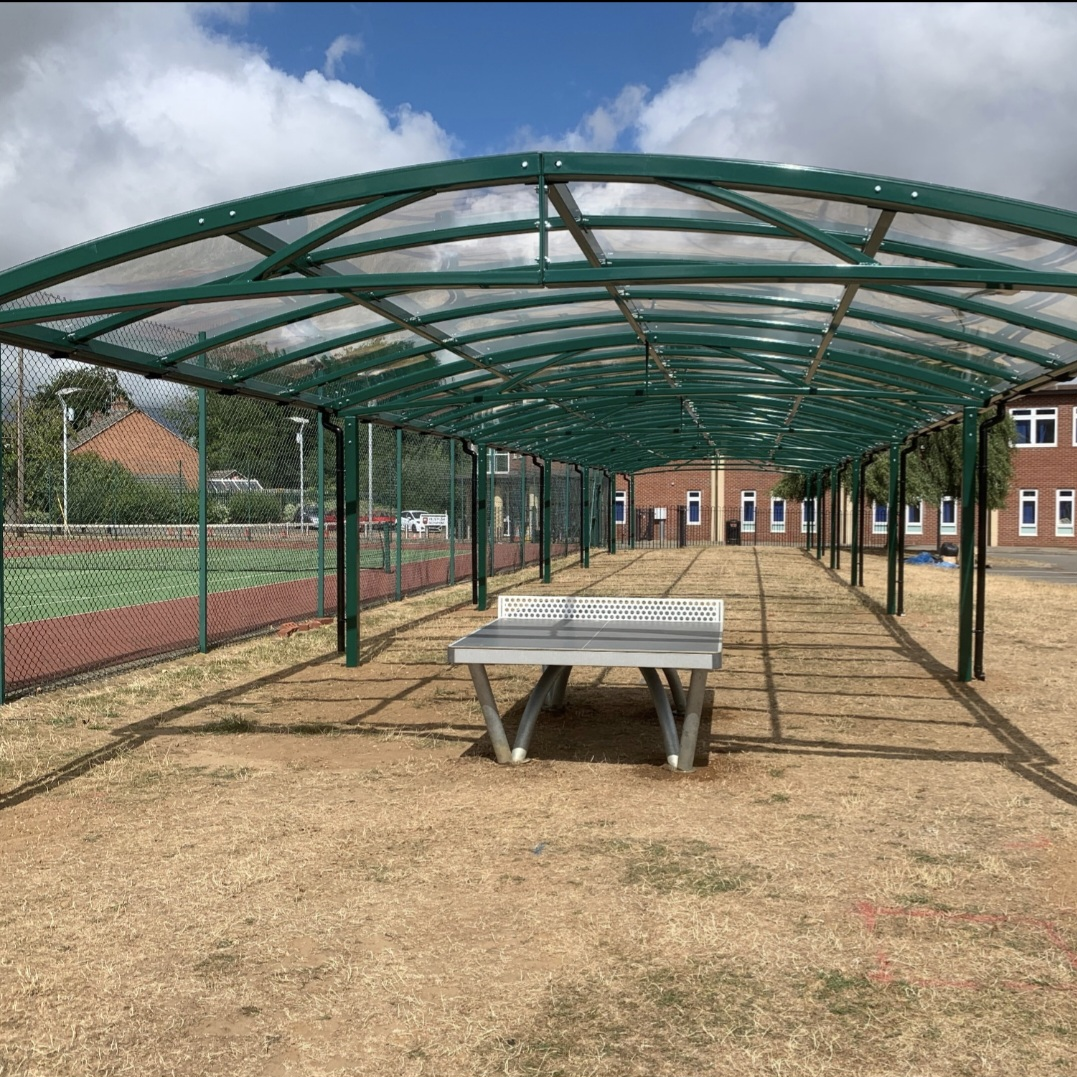
A covered MUGA is a permanent steel-framed roof structure fitted over a multi-use games area (MUGA) so that football, basketball, netball and other sports can be played through rain, wind and strong sun. MUGA stands for multi-use games area, the hard-surfaced pitch itself; the covered MUGA, or MUGA canopy, is the cover we design, manufacture and install above it.
Our covers use a powder-coated steel frame carrying a roof membrane or polycarbonate sheeting across large clear spans, sized so the roof reaches just beyond the court perimeter and keeps the playing surface dry. The sides are left open, so air moves freely and daylight reaches the court, which keeps the space bright and well ventilated. See our wider range of school canopies for other covered spaces we build for schools, or, for a club, leisure or community games area, our sports-area canopies.
What is the difference between a MUGA cover and a MUGA pitch?
A MUGA pitch is the playing surface itself, the marked hard court or artificial turf that football, netball and basketball are played on, while a MUGA cover, or covered MUGA, is the steel-framed roof structure fitted above an existing or new pitch. We supply and install the cover; we do not lay the sports surfacing beneath it.
This distinction matters at quotation stage because the two are priced and specified separately: the pitch contractor lays or resurfaces the court, fencing and line markings, while we design, fabricate and fit the roof, frame and supporting structure over the top. Many schools commission both as one project, and we are happy to work alongside a pitch contractor or design team so the canopy foundations, drainage and clearances suit the finished court.
Which covered MUGA is best?
The best covered MUGA is the one engineered to your court size, site and budget, so a specifier compares four things: the clear span the frame must achieve without intermediate posts, the roof material (polycarbonate for daylight and UV filtering, a roof membrane for a more economical full-weather cover), the frame material, and the height needed to clear players and any ball height in use.
For most school sites we specify a steel frame with polycarbonate sheeting, which keeps the court bright and lets daylight through the open sides. A roof membrane suits a larger span or a tighter budget where full weather cover matters more than daylight transmission. Timber framing is also available where a school wants the structure to match existing buildings.
Canopy forms and roof profiles compared
| Form | How it is built | Drainage | Access below | Best suited to |
|---|---|---|---|---|
| Mono-pitch | A single-slope roof on a steel frame | Falls to one side | Sits close to a wall or along a route | Walls, walkways and long building elevations |
| Curved (barrel-vault) | A curved roof on curved steel rafters | Sheds water off the curve to the eaves | More projection and headroom | Entrances, social spaces, cycle and buggy shelters |
| Cantilever | Roof carried from one line of columns or a wall fixing | Set by the roof profile | No front posts, so the space below stays clear | Entrances, drop-offs and play areas where columns would block access |
| Freestanding | Stands on its own posts and footings | Set by the roof profile | Posts on both sides; can stand anywhere on the site | Open ground, courts and routes away from buildings |
| Wall-mounted (lean-to) | One edge fixes to an existing wall | Falls away from the wall | Fewer posts, as the wall carries one edge | Play areas and nursery gardens beside a building |
Forms combine: a canopy can be a wall-mounted mono-pitch or a cantilevered curved roof. We set the profile, the drainage fall and the fixing at survey.
What is a covered MUGA made of?
A covered MUGA is made of a powder-coated steel frame carrying polycarbonate sheeting or a roof membrane across large clear spans, with the sides left open so air moves freely and daylight reaches the court.
Powder-coated steel frame
Engineered to span the court without intermediate posts and to clear players and ball height, finished in the colour your facility needs.
Polycarbonate or roof membrane
Polycarbonate sheeting keeps the court bright and filters UV; a roof membrane gives a more economical full-weather cover over a larger span.
Covers the whole court
Sized so the roof reaches just beyond the court perimeter, keeping the playing surface dry in wet weather.
Open sides for airflow and light
The open design keeps air moving and lets natural daylight in, so the court stays fresh and bright.
Roof materials compared
| Roof material | Daylight and UV | Weather cover | Span | Typical life |
|---|---|---|---|---|
| Polycarbonate sheet, 5mm or 8mm | Clear, opal or tinted; filters around 99% of UV | Water-resistant, sealed with a double rubber bead | Carried bay by bay on the steel frame | 20 to 30 years |
| PVC-coated polyester fabric | Translucent; gives shade and keeps the area bright | Weatherproof, tensioned to shed rain | Longer clear spans with few supports | 15 to 25 years |
| PTFE-coated glass fabric | Translucent, with a self-cleaning surface | Weatherproof, tensioned to shed rain | Larger or higher-profile spans | 25 to 35 years or more |
Typical lives are the figures given on our product pages. The steel frame usually outlasts the roof, and roof sheets or a membrane can be replaced without rebuilding it. We confirm the roof specification at survey.
What standard sizes do covered MUGAs come in?
A covered MUGA is sized to match the pitch it sits over, and most school multi-use games areas fall into a standard footprint of around 32 metres by 18 metres to 36 metres by 20 metres, sized to accommodate a five-a-side football pitch with a netball or basketball court marked within the same area.
Smaller sites specify a reduced court, often around 18 metres by 9 metres for a single sport or a tighter playground, while community and club sites sometimes extend to a full-size multi-court layout. Whatever the pitch dimensions, we design the roof and frame to clear the full court width and length with margin at the perimeter, and every cover is made to measure in size, shape and colour.
How much does a covered MUGA cost?
A covered MUGA costs £20,000 to £30,000 for a small or single-sport court and £30,000 to £45,000 for a standard school MUGA of about 32m x 18m, rising to £60,000 or more for a large clear-span cover or a full-size multi-court structure. These figures are for the cover only, not the pitch surfacing beneath it, and are indicative ranges to confirm at survey, not fixed prices.
Four things drive the figure: the clear span (a wider court needs more steel and a larger unsupported roof), the height and any wind loading on an exposed site, the roof specification (polycarbonate against a roof membrane), and the groundworks needed to found the frame around an existing or new pitch. We quote every covered MUGA after a site survey and provide CAD drawings and a specification for a governors' business case or a capital-funding application. Our guides to school canopy costs and funding a school canopy set out the budgets and routes schools use.
| Covered MUGA size | Indicative installed cost | Main cost drivers |
|---|---|---|
| Small or single-sport court | £20,000 to £30,000 | span, roof spec, groundworks |
| Standard school MUGA (approx. 32m x 18m) | £30,000 to £45,000 | clear span, frame height, foundations |
| Large or full-size multi-court cover | £45,000 to £60,000+ | span, wind loading, roof area |
Indicative UK ranges for the roof cover only, to confirm at survey, installed and excluding pitch surfacing, fencing or line markings. Our work is quote-based; we do not sell fixed-price units.
Do covered MUGAs need planning permission?
A covered MUGA often needs planning permission and building-regulations approval, because a permanent structure of this scale on a school or community site is not covered by the domestic permitted-development rights that apply to a house. Whether a full application is needed depends on the size of the cover, the site and whether it sits in a conservation area or near listed buildings.
The height and clear span of most covered MUGAs mean they are treated as a significant structure by planning departments, and building-regulations sign-off is generally required for structural loading. We supply the CAD drawings, structural calculations and specification your local authority, academy trust or building-control officer needs, and we can advise early in the design process on what a specific site is likely to require. Our guide to planning permission for canopies explains when a full application is needed.
How are covered MUGAs installed?
Canopies & Shelters installs covered MUGAs with our own teams across England, Scotland and Wales in four stages: a full site survey, a CAD design and specification for sign-off, UK manufacture of the frame and roof, then groundworks and the on-site build, planned around the school calendar to keep disruption to lessons and fixtures to a minimum.
Because a covered MUGA spans a full court, groundworks and foundations are more extensive than a smaller canopy, and we sequence the build so the pitch is out of use for as short a time as possible. Most schools prefer the main structural work during the summer or half-term holidays. Send us your court dimensions and drawing files, or arrange an early consultation, and our design team returns a scaled proposal and a programme that fits your holiday dates.
How long does a covered MUGA last?
A covered MUGA lasts 20 to 30 years or more. On a court that takes constant ball contact, the powder-coated steel frame is the long-life element and the roof sheets or membrane are the part most likely to be refreshed; individual sheets can be replaced without rebuilding the frame.
Routine care is a periodic clean and a check of the fixings and gutters. We re-clad and refurbish existing covered MUGAs as well as installing new ones.
What are the benefits of a covered MUGA?
A covered MUGA adds a usable, all-weather sports and PE space to a site: it keeps fixtures, PE lessons and lunchtime sport running in rain as well as sun, so a school is not planning around the forecast or losing the court to a wet afternoon, and pupils get far more usable hours on the pitch across the year.
Because the space works whatever the weather, many schools also let the covered MUGA out to local clubs and community groups for evening and weekend lettings, turning the structure into an income asset as well as a teaching one. The open sides keep the court bright and well ventilated, so it plays like an outdoor pitch rather than an enclosed hall, and it sits well alongside a separate playground canopy where a school wants covered play space as well as covered sport.
Covered MUGA canopies: recent projects
Real covered MUGA canopies we have designed, manufactured and installed, photographed on site.
Why choose Canopies & Shelters for covered MUGAs?
Canopies & Shelters designs a covered MUGA around the court you already have or the one being laid: the full width and length with a margin at the perimeter, clear height for play, and foundations set out with the pitch contractor.
We work with schools, academy trusts and local authorities, offer free quotations and early consultation with drawing files, and plan every install around the school calendar to protect lessons and fixtures. Every covered MUGA is made to measure for the court, and it sits alongside the rest of our school canopies on the same site.
Questions about covered MUGA canopies
Can a covered MUGA be used for community lettings?
Yes. Because the court is usable whatever the weather, many schools let their covered MUGA to local clubs and community groups outside school hours, which helps offset the cost of the structure over its life. For sizes, surfaces and covering one, see our guide to MUGAs.
Can you work alongside our pitch surfacing contractor?
Yes. Many schools commission the pitch and the cover as one project, and we work alongside the pitch contractor or design team so the canopy foundations, drainage and clearances suit the finished court.
When do schools usually build a covered MUGA?
Most schools prefer the main structural work during the summer or half-term holidays, and we sequence the build so the pitch is out of use for as short a time as possible.
In-house canopy design and manufacture, supply and install, UK-wide.
Get a quote for a covered MUGA
Send us a site plan, a photo or just a postcode, and our design team will come back with a drawing, a specification and a price for a covered MUGA.